Restorative Dentistry in Scottsdale
If you’ve been putting off restorative dentistry in Scottsdale because you weren’t sure where to start, GOREgeous Smiles handles the full spectrum of tooth repair and replacement under one roof. Dr. Rod W. Gore is one of only two dentists in Arizona to hold Accredited Member status with the American Academy of Cosmetic Dentistry, and that same eye for natural-looking results applies to restorative work too – the cracked molar a colleague might fix with a metal crown, we restore with porcelain that disappears against your existing teeth.
Restorative dentistry covers a wide range: tooth-colored fillings, inlays and onlays, ceramic crowns, dental bridges, dental implants, dentures and partials, root canal therapy, extractions, and full-mouth rehabilitation. Most patients arrive needing a few of these, not just one. The job at the consultation is figuring out the right combination and the right sequence.
The biggest question we hear from new restorative patients is some version of, “How long will this last?” Materials and home care matter, but bite mechanics matter more. A crown that sits in a balanced bite can last 15+ years; the same crown in an uncorrected grinding pattern fails much sooner. We’ll address both halves of that equation, not just the one that involves a drill. For patients with widespread wear or multiple failing restorations, our full-mouth rehabilitation approach addresses the whole bite at once.
On This Page
What Is Restorative Dentistry?
Restorative dentistry is the work that fixes teeth that are decayed, cracked, worn down, infected, or missing. The line between restorative and cosmetic gets blurry at the edges – a porcelain crown on a front tooth is doing both jobs at once – but the central job of restorative dentistry is bringing function back to teeth that have stopped doing their job. Eating without pain. Closing your bite the way it was designed to close. Talking without a denture moving.
Below are the procedures patients ask about most often. The right plan for you may use one of these. It may use four. We sort that out at the consultation.
Tooth-Colored Fillings
Composite resin tooth-colored fillings handle small to moderate cavities. We remove the decay, layer the resin, shape it to match the existing tooth, and cure it. Composite bonds directly to enamel and dentin, which means smaller preparations than the old metal fillings required and no silver showing when you laugh. For patients still carrying old amalgam fillings, swapping them out for composite is one of the lower-cost upgrades available, and it tends to make hot-and-cold sensitivity better, not worse.
Porcelain Inlays and Onlays
When a cavity or fracture is too big for a filling but not big enough to justify a full crown, porcelain inlays and onlays are the conservative middle ground. The lab fabricates a custom porcelain restoration that fits inside the chewing surface (inlay) or wraps over one or more cusps (onlay). They preserve more healthy tooth structure than a full crown does, and they hold up well to chewing forces because porcelain doesn’t shrink or expand with temperature swings the way old amalgams could.
Dental Crowns
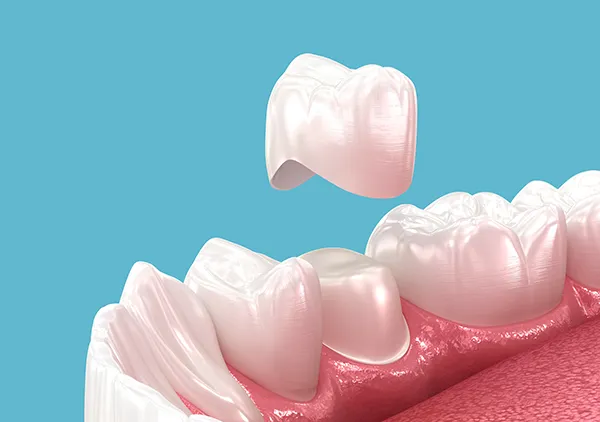 A dental crown covers the full visible portion of a tooth. Crowns are the standard restoration after a root canal, after a large fracture, or when a tooth has lost so much structure that a filling won’t hold. We use porcelain and high-strength ceramic for almost every crown we place. Porcelain crowns match adjacent teeth in color and translucency, which matters most on front teeth but matters more on back teeth than people expect – nobody wants a metallic glint in the back of their smile when they laugh. A dental crown covers the full visible portion of a tooth. Crowns are the standard restoration after a root canal, after a large fracture, or when a tooth has lost so much structure that a filling won’t hold. We use porcelain and high-strength ceramic for almost every crown we place. Porcelain crowns match adjacent teeth in color and translucency, which matters most on front teeth but matters more on back teeth than people expect – nobody wants a metallic glint in the back of their smile when they laugh.
Crowns last decades when the bite is balanced and the tooth underneath stays free of new decay. We design every crown with the bite in mind, not just the tooth, because a crown that’s too tall or too steep wears the opposing tooth and tends to fail early.
Even well-made crowns don’t last forever. The reasons we recommend replacement come down to a few patterns: decay starting at the margin where the crown meets the natural tooth, worn or fractured porcelain, or a crown that no longer matches surrounding teeth after years of small color and position shifts. We catch most failing crowns at routine exams before the patient feels anything, and a planned dental crown replacement is usually easier than waiting until the tooth underneath is in trouble.
Same-Day Crowns with CEREC
For eligible cases, our same-day crowns use CEREC technology to design and mill a custom porcelain crown chairside in a single appointment. We take a digital scan of the prepared tooth, the design software builds the crown to match your bite, and the in-office mill produces it while you wait. No temporary crown. No second appointment two weeks later. Same-day works for most posterior cases and many anterior cases; complex cosmetic crowns sometimes still go to the lab for color layering.
Dental Bridges
A dental bridge replaces one or more missing teeth using crowns on the natural teeth on either side of the gap as anchors, with a custom replacement tooth (called a pontic) filling the space between them. Bridges have been a workhorse restorative solution for decades and remain a strong option for patients who aren’t implant candidates or who want a fixed alternative to a partial denture. The trade-off is that traditional bridges require reshaping the two anchor teeth, which is why many patients now choose an implant-supported bridge or a single implant when the neighboring teeth are healthy and don’t need crowns for their own reasons. Existing bridges sometimes need follow-up work after years in place – worn pontics, an abutment crown that loosens, or decay developing on a tooth under one of the anchor crowns. Dental bridge repair and replacement addresses those problems, and we sometimes recommend moving to an implant when the underlying anchor teeth have failed entirely.
Dental Implants, Single Through Full-Arch
A dental implant replaces the root of a missing tooth with a titanium post that fuses with your jawbone. After the post integrates, we attach a custom porcelain crown on top. The result looks and feels like a natural tooth, transmits chewing forces to the bone the way a natural tooth does, and doesn’t require reshaping any neighboring teeth.
For patients missing several adjacent teeth, implant-supported bridges restore multiple gaps without relying on natural teeth as anchors. For full-arch tooth loss, full mouth dental implants anchor a complete set of teeth on as few as four to six implants per arch. We use 3D cone beam imaging and a surgical guide to plan implant position before any surgery, which is the difference between an implant placed where it’s convenient versus an implant placed where the final crown actually needs it.
Dentures and Partials
Custom full and partial dentures replace multiple missing teeth and restore the support a full set of teeth gives to the lower face. Modern denture materials fit better, look more natural, and weigh less than the dentures most patients remember from older relatives. Partials specifically work well for patients who still have several healthy natural teeth and want to keep them, with the partial clipping discreetly into the existing dentition rather than covering the palate completely.
For patients who’ve worn conventional dentures and struggled with movement during eating or speaking, implant-supported dentures snap onto two to four implants and stop the slipping problem entirely. The denture still comes out for cleaning, but it stays put while it’s in.
Dentures need ongoing care to keep fitting and looking right. Gum tissue and bone change shape gradually after teeth are lost, which means most dentures need a reline every year or two to continue seating correctly against the ridge. We also handle denture repair and relines for cracked acrylic, broken or missing artificial teeth, and worn chewing surfaces – most of those issues are repairable without replacing the whole denture.
Root Canal Therapy
When decay or trauma reaches the pulp inside the tooth, root canal therapy is what saves the tooth from needing extraction. We remove the infected pulp, disinfect and shape the canals, and seal the space with a biocompatible filling material. After the canal is sealed, we typically place a crown on the tooth to reinforce what’s left of the natural structure. Most patients are surprised how comfortable a root canal actually is. The procedure has a worse reputation than it deserves, in part because the pain that drives people to need one is what they associate with the procedure itself.
Tooth Extractions When a Tooth Can’t Be Saved
Sometimes a tooth is too far gone for a filling, crown, or root canal. A deep vertical fracture, severe periodontal involvement, or an infection that’s migrated into the bone may make extraction the safer choice. Simple extractions remove fully erupted teeth in one visit; surgical extractions handle broken or impacted teeth and require a small gum incision. We plan replacement (typically an implant or bridge) at the same consultation when possible, because empty sockets begin losing bone the day the tooth comes out, and bone loss makes future tooth replacement harder.
Same-day situations where a tooth is causing severe pain or has been knocked out get triaged ahead of routine appointments. Details on our emergency tooth extraction page.
Full-Mouth Rehabilitation
Full-mouth rehabilitation coordinates multiple restorative treatments – crowns, implants, onlays, root canals, bite correction – into a single planned sequence. The patients who benefit most are the ones with widespread wear from grinding, multiple failing restorations from earlier eras of dentistry, full-arch tooth loss, or chronic TMJ pain caused by an unbalanced bite. We use diagnostic mounted models, photographs, and a wax-up to plan the new bite before we touch any teeth. The wax-up is the critical step. It lets you see and feel the proposed result before any irreversible work begins.
Periodontal Therapy as the Foundation
Healthy gums and bone are what hold restorations in place. Gum disease therapy addresses bacterial infection, reduces pocket depths, and stabilizes the tissues that support every other piece of restorative work. Crowns and bridges and implants placed over untreated gum disease tend to fail. We address periodontal health first or alongside any major restorative plan, not as an afterthought. Implants in particular are vulnerable to a form of gum disease called peri-implantitis, where bacterial infection attacks the bone and tissue supporting the implant. Peri-implantitis treatment takes a different approach than standard gum disease therapy, and we screen for it at every recall visit for our implant patients.
Adjunct Services Restorative Patients Often Need
Restorative outcomes improve when supporting services are included in the plan rather than treated as separate problems:
| • |
Dental bonding
– Repairs small chips and closes minor gaps with composite that matches existing tooth color.
|
| • |
TMJ and bite therapy
– Manages clenching, grinding, and joint strain that wears teeth and damages restorations.
|
| • |
Night guards and sports guards
– Protect natural teeth and restorations from grinding and athletic impact.
|
| • |
SureSmile clear aligners
– Straighten teeth before restorative work to simplify hygiene and improve final esthetics.
|
| • |
Senior dental care
– Tailored strategies for dry mouth, medication-related risks, and prosthetic maintenance.
|
| • |
Sensitive teeth solutions
– Desensitizing treatments and material choices that make daily care comfortable. |
These aren’t add-ons. They’re what protects the restorative work from breaking down sooner than it should.
Your Restorative Dentist in Scottsdale
Dr. Rod W. Gore earned his Doctor of Dental Surgery from Northwestern University in 1987 and has practiced in Scottsdale for over 38 years. He’s one of only two dentists in the state of Arizona to hold Accredited Member status with the American Academy of Cosmetic Dentistry, a peer-reviewed credential that requires submitting completed clinical cases for examination by other accredited dentists rather than simply taking a course. The credential matters on the restorative side too. Crowns, bridges, and full-mouth rehabilitation cases involve constant aesthetic decisions that shape how the result looks and how natural it feels in your mouth.
Dr. Gore’s bio details his founding of the Phoenix Esthetic Study Club in 1998 to educate other dentists in the art and science of cosmetic and restorative dentistry, his clinical instructor positions with the Pacific Aesthetic Continuum at the University of the Pacific and with the Las Vegas Institute for Advanced Dental Studies, and his ongoing role as an active AACD Examiner evaluating other dentists pursuing the same credential.
The Restorative Dentistry Process
 Restorative care is sequenced, not rushed. Most cases at our Scottsdale office move through these stages, with diagnosis and planning happening before any irreversible work begins. Local anesthesia is standard for any procedure that needs it, and sedation options are available for patients who’d rather sleep through longer appointments. Restorative care is sequenced, not rushed. Most cases at our Scottsdale office move through these stages, with diagnosis and planning happening before any irreversible work begins. Local anesthesia is standard for any procedure that needs it, and sedation options are available for patients who’d rather sleep through longer appointments.
Comprehensive Exam and Diagnosis
Your first visit is a thorough exam plus imaging. Digital X-rays, often a 3D cone beam scan if implants or full-mouth work is on the table, intraoral photos, and a bite assessment. We catalog every tooth that needs attention and rank it by urgency. A throbbing molar comes first; a chipped premolar that’s been chipped for two years can wait if it has to. Patients leave the consultation with a written treatment plan and a clear estimate before any treatment is scheduled.
Stabilizing Urgent Issues First
If something is actively painful, infected, or progressing fast, we treat it first. Root canals, extractions, and temporary restorations on broken-down teeth come before elective work. Stabilizing first protects the rest of the plan from getting derailed by a flare-up halfway through.
Repair Versus Replacement
For each compromised tooth, we make a repair-or-replace decision based on how much healthy tooth structure is left. Repair options – fillings, inlays, onlays, crowns, root canals – preserve the natural tooth when there’s enough left to preserve. Replacement options – bridges, implants, partials, dentures – come into play when the tooth itself can’t hold a restoration anymore. Implants are usually the better long-term replacement when they’re an option, because they don’t require reshaping neighboring teeth and they keep the underlying bone from atrophying.
Bite and Foundation Work
Before placing major restorations, we address the bite. Worn-down teeth, persistent jaw pain, or a history of cracked teeth means the bite is doing damage faster than restorations can keep up. Periodontal treatment, occlusal adjustment, and protective night-guard therapy may all play a role here. Restorations placed over an unstable foundation fail early; restorations placed over a stable one tend to last as long as the materials are designed to last.
Restoration and Follow-Up
We complete the restorative work in the order the plan calls for, with follow-up visits to check fit, comfort, and bite. After the final restorations are placed, you stay on a routine cleaning and exam schedule that’s often more frequent than standard recall – every three to four months for patients with extensive restorative work, every six months for less complex cases.
Benefits of Restorative Care
The most direct benefit is the obvious one: chewing without pain, eating the foods you used to avoid, and stopping a problem before it becomes a bigger one. Patients who’ve had a tooth quietly bothering them for months are often surprised how much daily energy that low-grade discomfort was eating up.
The clinical benefits are quieter but more important over time. Restoring decayed teeth stops decay from spreading. Replacing missing teeth keeps neighboring teeth from drifting and prevents the bone loss that follows extraction. Treating the bite reduces wear on every tooth still in your mouth. A well-fit restoration is invisible in the mouth and unnoticeable in daily life, which is the result we’re aiming for.
Modern restorative materials hold up. Composite fillings typically last seven to ten years before they need replacement. Porcelain crowns and bridges commonly run ten to fifteen years, often longer with reasonable home care. Dental implants integrate with the bone and routinely last decades; the crowns or bridges attached to them follow normal restoration timelines. The two factors that extend longevity for any restoration are catching problems early at routine dental exams and protecting against grinding with a night guard if you grind.
For patients with extensive restorative needs, finishing the plan often shifts how they engage with their own mouths. They start flossing because there’s now something worth protecting. They schedule cleanings on time. The behavior change matters as much as the materials.
Why Choose Our Practice for Restorative Dentistry
The most concrete differentiator at our Scottsdale practice is the AACD Accreditation Dr. Gore holds. The credential is widely associated with cosmetic dentistry, but it’s an even more useful filter for restorative work, because every restorative case involves cosmetic decisions whether the patient frames it that way or not. A crown on a back tooth still has to look like a tooth. A full-arch implant case still has to read as a natural smile. Two dentists in the entire state of Arizona currently hold this credential.
Beyond the credential, Dr. Gore has spent decades teaching other dentists how restorative cases get planned and sequenced. He founded the Phoenix Esthetic Study Club in 1998 specifically to give local dentists a forum for working through complex cosmetic and restorative cases together. Teaching keeps you honest about case selection and bite mechanics, and that discipline shows up in patient outcomes.
We invest in the technology that makes restorative care faster and more accurate. Our dental technology includes CEREC for same-day crowns, 3D cone beam imaging for implant planning, intraoral scanning that replaces traditional impression material, SprintRay 3D printing for in-office models and night guards, and an MLS therapeutic laser that reduces post-operative inflammation and recovery time. Digital workflows shorten the time patients spend in the chair compared to traditional impression-and-lab cycles.
What our restorative patients say about working with us:
“I had an upper left side molar crown replaced today. Dr Gore did excellent work. This was my second crown by Dr Gore. I have had many over the years and finding Dr Gore was a blessing. I will never go anywhere else. His assistant Stephanie works very well with Dr Gore. Both are very kind and thoughtful, asking me how I am doing throughout the procedure.”
– Mary N., Google review
“Dr Gore and his staff are incredibly professional and diligent in finding the solution for your dental needs. I’ve had veneers, crowns and cavities filled and have always had great results. I couldn’t recommend them more.”
– Darla H., Google review
“I have been a patient of Dr. Gore since 1995 when I moved to the valley. I will be a patient of Dr. Gore until either he stops doing dentistry or I stop needing it. He and his entire staff have taken such great care of my family and I over the years. My wife who became significantly disabled in the past few years requires extra care now and Dr. Gore and his team have been amazing with her.”
– Ed C., Google review
More patient feedback on our reviews page.
Restorative Dentistry Cost and Financing
Cost is a fair concern with restorative dentistry, and we’ll be straight with you about how it works at our office. The cost of any restorative plan depends on what’s actually involved – a single composite filling is in a different category from a porcelain crown, which is in a different category from a multi-implant full-arch case. We give you a written estimate after the consultation, before any work begins, so there are no surprises later.
Restorative dentistry has more insurance coverage than cosmetic work does. Fillings, crowns on damaged teeth, root canal therapy, simple extractions, and many bridge cases are partially covered by most dental plans. Implants vary by carrier, with some plans covering nothing and others covering a portion of the implant or the crown. Our front office team verifies your benefits with your carrier (we currently accept Cigna, and we work with most other major PPOs) and lays out exactly what your insurance will and won’t pay before you commit. Our financial and insurance page lists accepted plans and outlines payment options.
For patients without dental insurance, the GOREgeous Membership Plan is an in-office alternative that covers preventive care plus a 20% discount on most restorative treatment for a flat annual fee. Flexible third-party financing is also available so larger restorative plans can fit a monthly budget rather than requiring everything upfront. Call 480-585-6225 for a personalized estimate after we’ve seen the teeth in question.
Schedule Your Restorative Consultation
A good restorative outcome starts with a thorough consultation and a written plan. Call GOREgeous Smiles at 480-585-6225 or use our Request an Appointment page to schedule. We’re located at 8535 E. Hartford Drive #208 in Scottsdale, AZ 85255-5438. You can also reach us through our Contact page with any questions before booking.
Frequently Asked Questions
What is the difference between restorative and cosmetic dentistry?
Restorative dentistry repairs or replaces teeth that are damaged or missing so the bite functions normally. Cosmetic dentistry changes how teeth look. The line is blurry: a porcelain crown on a front tooth is doing both jobs, and a full-mouth rehab corrects function and appearance simultaneously. The useful question is which job is doing the heavier lifting on your specific case. If you’d be in pain or losing teeth without the work, it’s mostly restorative. If the teeth are healthy and you just want them to look different, it’s cosmetic.
How long do dental crowns and fillings actually last?
Material is part of the answer – composite fillings tend to run seven to ten years, ceramic crowns ten to fifteen and often longer – but bite mechanics matter more than the numbers suggest. The same crown in a balanced bite outlasts the same crown in an uncorrected grinding pattern by a decade or more. Whether you grind, whether you wear a guard, how often you make it to cleanings, and whether new decay starts at the margin all push the timeline up or down. Asking which lab made the crown is the wrong question. Asking how the bite is doing is the right one.
Are dental implants permanent?
The implant post itself, the titanium piece that integrates with the bone, is designed to be permanent and routinely lasts decades. The crown attached to the top of the implant is a normal porcelain restoration with a normal restoration lifespan, typically ten to fifteen years before it might need replacement, the same as any other porcelain crown. So implants are “permanent” in the way a hip replacement is permanent: the foundation lasts, the wear surface gets renewed periodically. Most patients who get implants in their fifties or sixties never need to revisit the implant post itself.
Will my dental insurance cover restorative procedures?
Most plans cover at least part of fillings, root canal therapy, simple extractions, and crowns on damaged teeth, often at 50 to 80 percent depending on the procedure and your annual maximum. Implants vary widely; some plans cover the crown but not the post, others cover neither. The two questions to ask your carrier before treatment are which procedures are covered at what percentage, and whether you have unused annual maximum benefits before the year resets. Our front office handles those calls. Our financial and insurance page lists accepted plans, and we currently accept Cigna and most other major PPOs.
Does a root canal hurt?
Less than the toothache that brought you in. Modern root canal technique has the area fully numb with local anesthesia for the procedure itself, and most patients describe the experience as comparable to getting a filling. The pain people associate with “needing a root canal” is the pain from the infected pulp, not from the procedure that fixes it. There’s often mild tenderness for a day or two afterward as the surrounding tissue settles down, and over-the-counter pain medication usually handles it. Patients with significant dental anxiety can also be offered sedation options for the appointment.
Should I get a bridge or an implant for one missing tooth?
Implant when it’s an option, bridge when it isn’t. The reason is that a bridge requires reshaping the two natural teeth on either side of the gap to serve as anchors, and most of the time those anchor teeth are healthy and don’t need crowns for their own reasons. An implant replaces only the missing tooth and leaves neighbors alone. The cases where a bridge still makes sense are when the anchor teeth already need crowns for unrelated reasons, when bone volume can’t support an implant, or when a medical condition makes implant surgery inadvisable. The consultation imaging tells us which path your specific situation supports.
What does full-mouth rehabilitation actually involve?
A coordinated plan that addresses every tooth in your mouth at the same time, sequenced so the bite ends up balanced. For some patients that means crowns on most teeth, replacement of all old metal fillings, and bite refinement. For others it means a combination of crowns, bridges, implants, and root canal therapy on the teeth that need it. The defining feature isn’t which procedures are involved, it’s that they’re planned together rather than done one at a time over years. Cases typically run two to nine months from start to finish depending on whether implants are part of the plan and how much healing time those require.
Why should I choose GOREgeous Smiles for restorative dentistry in Scottsdale?
Two reasons that filter most of the noise. First, AACD Accredited Member status is a peer-reviewed credential held by two dentists in Arizona, and the case-evaluation process behind it tests the judgment restorative dentistry actually requires. Second, dentists who teach develop case-planning discipline that often doesn’t survive in offices where every case is solo work. Dr. Gore has taught restorative case planning to other dentists for decades through the Phoenix Esthetic Study Club he founded in 1998 and through his clinical instructor positions. The combination of accreditation and active teaching is uncommon, and it’s what we’d encourage you to look for in any restorative dentist you’re considering. |