Cavity Risk Assessment in Scottsdale, AZ
 Cavity risk assessment at GOREgeous Smiles in Scottsdale, AZ is the part of preventive dentistry where we figure out why some patients keep getting cavities while others rarely do, and what to actually do about it. The framework we use is called CAMBRA, short for Caries Management By Risk Assessment. It was developed at UCSF and is widely used across evidence-based dentistry. Instead of treating every patient the same, we tier preventive care to your actual risk. Cavity risk assessment at GOREgeous Smiles in Scottsdale, AZ is the part of preventive dentistry where we figure out why some patients keep getting cavities while others rarely do, and what to actually do about it. The framework we use is called CAMBRA, short for Caries Management By Risk Assessment. It was developed at UCSF and is widely used across evidence-based dentistry. Instead of treating every patient the same, we tier preventive care to your actual risk.
Most adults assume cavities come down to brushing and sugar. Those matter, but they’re two factors out of about a dozen. Saliva flow, the bacterial strains living on your teeth, the medications you take, the depth of grooves on your back teeth, gum recession, and the margins around old fillings all change your odds. Two patients with identical home care can end up at very different risk levels, and the right prevention plan looks different for each.
A risk assessment isn’t a test you pass or fail. The point is to figure out where you actually stand so we can match the prevention plan to your situation. Low-risk patients usually need very little beyond the basics. Moderate-risk patients benefit from a few targeted additions. High-risk patients need a real plan, because catching the pattern early prevents years of fillings, crowns, and root canals.
On This Page
What Is Cavity Risk Assessment?
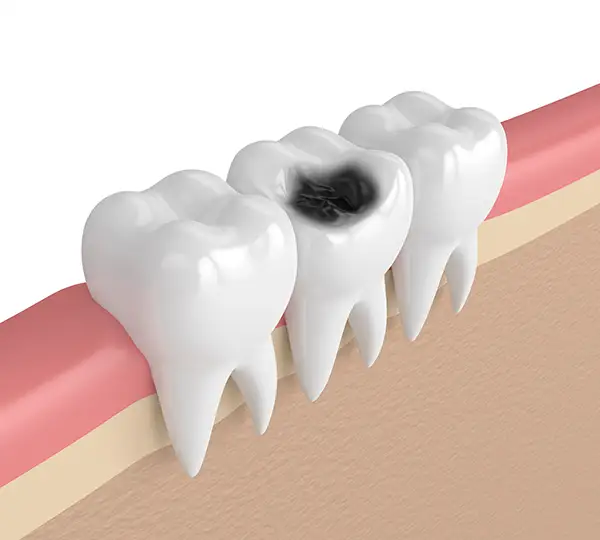 Cavity risk assessment is the systematic evaluation of how likely you are to develop new cavities, based on your specific biology, habits, and dental history. It looks at the factors that drive decay and assigns you a risk category – low, moderate, or high – that tells us how aggressive your prevention plan needs to be. The assessment itself usually takes less than ten minutes and happens during your exam. Cavity risk assessment is the systematic evaluation of how likely you are to develop new cavities, based on your specific biology, habits, and dental history. It looks at the factors that drive decay and assigns you a risk category – low, moderate, or high – that tells us how aggressive your prevention plan needs to be. The assessment itself usually takes less than ten minutes and happens during your exam.
Why Risk-Based Prevention Matters
Two patients can brush exactly the same and end up with very different mouths. One has bone-dry mouth from a daily medication and an aggressive bacterial mix; the other produces saliva like a fountain and has a quieter bacterial profile. Same brushing, very different risk. Treating both the same way wastes time on the low-risk patient and underprotects the high-risk one. Risk assessment fixes that mismatch so each patient gets care that matches their actual situation.
What We Actually Look At
The factors that drive cavity risk are biological, behavioral, and structural. We review your cavity history, since recent cavities are the strongest single predictor of future ones. We look at your saliva flow next, because saliva is your mouth’s main defense and conditions like dry mouth from medication or autoimmune disease can knock that defense out. We also look at your bacterial load and the strains of Streptococcus mutans you carry, your diet pattern (where the frequency of sugar and refined carbs matters more than the total amount), and your fluoride exposure from water, toothpaste, and professional applications. Medical conditions and medications matter too, especially anything that affects saliva flow. Structural factors round it out: the depth of grooves on back teeth, gum recession that exposes softer root surfaces, and the margins around existing fillings and crowns where new decay tends to start.
How a Risk Assessment Differs from a Dental Exam
A regular dental exam checks for cavities you already have. A risk assessment forecasts cavities you might develop. They’re complementary, not redundant. The exam catches active problems; the risk assessment shapes the prevention plan that aims to keep new problems from showing up at the next exam. Both are part of how we approach preventive care at our Scottsdale office.
Your Cavity Risk Assessment Team in Scottsdale
Cavity risk assessment is one of those services where decades of clinical experience matter more than any single piece of technology. Pattern recognition – knowing which combinations of factors tend to lead to which outcomes over 5 or 10 years – comes from seeing many patients return year after year. Dr. Rod W. Gore has been practicing in Scottsdale for over 38 years, and that continuity is what gives risk-based prevention its predictive power. Dr. Gore’s bio covers his Doctor of Dental Surgery from Northwestern University in 1987, his founding of the Phoenix Esthetic Study Club in 1998, and his ongoing role as an active AACD Examiner.
The Cavity Risk Assessment Process
 The assessment moves through four stages, all in the same appointment as your exam. Most patients are surprised by how short it is. The assessment moves through four stages, all in the same appointment as your exam. Most patients are surprised by how short it is.
Risk History and Habits Review
We start by asking about your cavity history over the past few years, the medications you currently take, your eating and snacking patterns, your fluoride sources, and your home care routine. The questions sound basic, but the answers usually do most of the work. A patient who has had three cavities in the last two years and takes a medication that causes dry mouth is already in a different risk tier than a patient who has been cavity-free for a decade.
Oral Exam and X-Ray Review
Next we examine your mouth specifically through a risk lens. We look for early demineralized areas (white spots that haven’t yet broken through into cavities), the condition of your existing fillings and crowns, the depth of grooves on your back teeth, and signs of gum recession or root exposure. Bitewing X-rays show decay between teeth that isn’t visible on the surface. For patients with concerning findings, we may also note salivary flow during the exam or recommend a saliva test in cases where dry mouth seems to be a major factor.
Risk Categorization
Based on what we find, we assign a category: low, moderate, or high. The categorization is honest and not graded on a curve. A patient who hasn’t had a cavity in fifteen years gets called low risk. A patient with three new cavities and root exposure gets called high risk. Most adults fall somewhere in the moderate range, where small adjustments can make a real difference.
Tiered Prevention Plan
Your category determines what we recommend next. Low-risk patients typically continue with regular six-month cleanings and standard fluoride toothpaste. Moderate-risk patients usually add professional fluoride varnish at cleanings and may benefit from sealants on grooved back teeth. High-risk patients get a real plan: prescription-strength fluoride toothpaste, more frequent cleaning intervals, possibly xylitol products, dietary counseling, and in some cases targeted fluoride treatments or antibacterial rinses. We write the plan down and give you a copy to track over time.
Benefits of Knowing Your Cavity Risk
The most concrete benefit is catching the pattern before it costs you teeth. A patient who learns at age 35 that they are high risk – because of a medication, recently developed dry mouth, or genetics – can change course before a chain of fillings turns into crowns and root canals at age 50. That is a real timeline difference, not a marketing claim.
A second benefit is escaping the fillings-beget-fillings loop. Every restoration creates margins where new decay is more likely to start. Patients who quietly accumulate fillings over decades often find that those margins fail in clusters, requiring crowns and sometimes extractions. Risk assessment helps interrupt that loop by addressing the underlying conditions, not just the holes that have already formed.
There is also a benefit for low-risk patients: not being overtreated. If you have gone fifteen years without a cavity, you don’t need a cabinet full of prescription products and four cleanings a year. Risk assessment gives us a defensible reason to keep your care simple when simple is what is actually appropriate. Knowing when more intervention helps and when it doesn’t is a real part of preventive dentistry.
The last benefit is an honest, useful conversation. Patients leave the appointment knowing why they are getting the recommendations they are getting, not just what they are. That tends to make home care stick better.
Why Choose Our Practice for Cavity Risk Assessment
The single most useful thing for risk assessment is patient continuity over years. We have had patients in our chairs for two and three decades, which means our risk categorizations are calibrated against actual long-term outcomes, not textbook averages. Shawna Aguirre, our hygienist, has been at the practice since 2007 – she sees the same patients return year after year and notices when something has shifted between visits.
Our office uses digital X-rays for the cleanest detection of decay between teeth, intraoral cameras to show patients exactly what we are seeing, Velscope for oral cancer screening (which doubles as a chance to spot early soft-tissue changes that correlate with risk), and 3D Cone Beam CT imaging when a case calls for it. The technology supports accurate assessment without making the appointment feel high-tech for its own sake.
For patients whose assessment puts them in the moderate or high tier, we have the in-office options to actually act on the plan. Professional fluoride applications, prescription products available through our office, and more frequent hygiene scheduling are all things we coordinate from one place. You don’t leave with a long list of recommendations and have to track down the products yourself.
What our patients say about their care here:
"Dr Gore and his staff are incredibly professional and diligent in finding the solution for your dental needs. I’ve had veneers, crowns and cavities filled and have always had great results. I couldn’t recommend them more."
– Darla H., Google review
"I’ve been a patient of Dr. Gore’s since 1991. He’s an amazing dentist. My teeth are in exceptional shape due to the fact that Dr. Gore is the best in his field. He’s patient, kind, and wears a smile. He always explains in detail what needs to be done in order for an healthy smile. He continues to be my families dentist. Thank you. Dr. Gore."
– Dorina W., Google review
"Dr. Gore is simply the Best Scottsdale Dentist! I have never had such a thorough examination and analysis of my teeth and mouth. The staff is incredible! They are professional, personable, and just great to be with!"
– Jeff H., Google review
More patient feedback on our reviews page.
Cost and Insurance
Cost matters, and we want to be straight with you about how it works. The risk assessment itself happens during your comprehensive exam, which means most patients see no separate charge for the assessment – it is bundled into the visit you would be having anyway. Targeted preventive interventions that follow from a moderate or high-risk finding (additional fluoride applications, prescription products, more frequent cleanings) may carry their own coverage rules.
Most dental insurance plans treat preventive care more generously than restorative work, and exams and cleanings are usually fully or near-fully covered. We currently accept Cigna directly, and we file out-of-network claims for patients on most other major PPO plans. Our front office verifies your benefits with your carrier before your visit so you know what to expect. Our financial and insurance page lists accepted plans and outlines payment options.
For patients without dental insurance, the in-office GOREgeous Membership Plan covers two annual exams, two cleanings, fluoride, and unlimited X-rays for a flat annual fee – which means cavity risk assessment is included as part of the standard exam workflow. The plan also includes a 20% discount on additional treatment, which can offset the cost of any moderate or high-risk follow-up care that ends up being recommended.
Schedule Your Visit
Risk assessment is most useful before a problem develops, not after. Call GOREgeous Smiles at 480-585-6225 or use our Request an Appointment page to schedule. We’re located at 8535 E. Hartford Drive #208 in Scottsdale, AZ 85255-5438. You can also reach us through our Contact page with any questions before booking.
Frequently Asked Questions
How often should my cavity risk be re-evaluated?
Most patients are re-evaluated annually as part of the yearly comprehensive exam. Moderate and high-risk patients benefit from re-evaluation every six months because the changes that move someone between tiers can happen quickly. Low-risk patients are generally fine with annual reassessment. Anything that changes your medical situation – a new prescription, pregnancy, a recent illness, a course of chemotherapy or radiation – is a reason to reassess sooner rather than wait.
Does being high risk mean cavities are inevitable?
High risk is a probability, not a destiny. Most patients who follow through on a high-risk prevention plan see a noticeable drop in new cavities within the first year, and many stop developing new ones. The label is meant to point us at the right interventions, not to predict what is going to happen no matter what you do.
Can my risk level change over time?
Yes, and it often does. New medications that reduce saliva flow, hormonal changes during pregnancy, gum recession that exposes softer root surfaces, and changes in diet or stress can all push you from one tier to another. Risk is a snapshot of your current situation, which is why we re-evaluate at each comprehensive exam rather than treating your first categorization as final.
What changes for low-risk patients?
Less than you might expect. We don’t push prescription products, four-times-a-year visits, or expensive add-ons on patients whose mouths don’t need them. The main difference is what we keep watching for. A previously low-risk patient who starts a medication that causes dry mouth can move into a different conversation quickly, and pregnancy or a new medical diagnosis can shift the picture too. Catching that shift early is the real reason we keep reassessing even when nothing seems to have changed.
Are children assessed the same way as adults?
The framework is the same, but the factors weight differently. For kids we pay closer attention to snacking patterns, fluoride exposure, the depth of grooves on newly erupted permanent molars (which often warrant sealants), and any orthodontic appliances that make brushing harder. Pediatric high-risk patients benefit from earlier and more frequent fluoride applications. Risk assessment is part of how we approach care for kids and teens at our office, not just adult patients.
Will I need a saliva test or other special procedures?
Most patients don’t. The standard assessment relies on history, oral exam, and X-ray review – that combination is enough to categorize the majority of patients accurately. We add saliva flow testing or bacterial culture in specific cases where dry mouth is suspected as a major factor or where a patient is developing cavities despite seemingly good home care. Those tests are quick and simple, and we discuss them with you before recommending one.
Will dental insurance cover the assessment?
Most plans do. The risk assessment is bundled into the comprehensive exam code, so coverage matches what your plan pays for the exam itself – which is typically the most generous part of dental coverage. The interventions that may follow from a moderate or high-risk finding – extra fluoride applications, prescription products, additional cleanings beyond the standard two per year – have their own coverage rules. We walk through what’s covered and what isn’t before you commit to anything. |